
7 Best AI Voice Agent Platforms for Businesses in 2026
- By Deepak Dutta
- 9 min read
Table of Contents
Key Takeaways
- Compare the 7 leading platforms: Maica, RingCentral, ElevenLabs, PolyAI, Vapi, Retell AI and Bland AI serve different needs, from multilingual workflows to enterprise support and custom voice automation.
- Prioritize production reliability: evaluate latency, call handling, integrations, compliance controls and performance under real-world conditions, not scripted demos.
- Match the platform to your use case: accurate customer support, high-quality speech, enterprise contact center capabilities or developer-level customization.
- Calculate total cost of ownership: include telephony, speech and language model usage, integrations, human escalations, overage charges and minimum commitments.
- Test language and compliance requirements: validate pronunciation, accents, numerical accuracy, consent handling and data protection with real calls in your target markets.
- Run pilots before committing: shortlist two or three vendors, set measurable success criteria, verify references, and review pricing, configuration limits and exit terms.
Introduction
AI voice agents are moving from pilot projects to production systems. Not long ago, companies tested a single call flow; today they deploy automated voice agents across support lines, sales outreach and scheduling. The question is no longer whether voice automation works, but which vendor is right. The vendor field has grown just as fast, with a wide range of architectures, pricing models and levels of enterprise readiness.
This guide looks at seven AI voice agent platforms used for real business applications such as appointment booking, sales and customer support. It explains how we selected them, what each one does well and gives you a practical framework for your own evaluation.
Each profile covers the pricing model, strengths, one honest limitation and best-fit use cases. Rates change often, so confirm current pricing with each vendor before setting a budget or signing an agreement.
What Makes an AI Voice Agent Platform Business-Ready
Inclusion required evidence of live business deployments, not demo-stage products. We screened vendors on four criteria: verified production use in support, sales or booking; native integrations with CRMs and telephony; response latency that sustains natural conversation; and documented compliance controls.
1. Why reliability matters more than demo quality
These standards matter because enterprise AI voice agents carry more risk than chat tools. A misheard account number or a missed consent disclosure creates real liability. A polished demo is not the right way to judge business voice automation; the right test is whether it holds up when it is needed.
Latency deserves special attention: when an agent pauses too long, callers talk over it or hang up.
2. Market growth and category confusion
The urgency comes from rapid market growth. Meticulous Research projects the Voice AI Agents market will grow at a CAGR of 24%, from USD 5.10 billion in 2026 to USD 43.83 billion by 2036. Research firms define the category differently, so forecasts vary widely. Treat any single figure as directional.
3. Disclosure
Maica publishes this guide. Maica was held to the same evidence standard as every other vendor and is described by its stated strengths and limitations only.
The 7 Best AI Voice Agent Platforms
The list mixes enterprise suites and developer toolkits, because buyers often have to choose between the two. The order does not imply a ranking. For independent user ratings, G2's conversational AI listings are a useful starting point. Here is a summary, followed by detailed profiles.
| Platform | Best for | Pricing model |
|---|---|---|
| Maica | Multilingual and calculation-sensitive workflows | Custom pricing, no public rate card |
| RingCentral | Organizations already on RingCentral UC | Seat-based add-ons or usage tiers |
| ElevenLabs | Voice quality and language coverage | Usage-based, from about $0.08 to $0.10/min |
| PolyAI | High-volume enterprise support calls | Custom enterprise contracts |
| Vapi | Engineering teams building custom workflows | Per-minute platform fee plus provider costs |
| Retell AI | Inbound and outbound agents with moderate engineering | Usage-based, billed per minute |
| Bland AI | High-volume outbound and inbound calling | Per-minute usage with plan tiers |
1. Maica
Best for: Teams that need an AI agent solution for multilingual support and booking workflows where accuracy with numbers such as fees, balances or quotes matters more than conversational flair.
Strengths: Deterministic logic for critical calculations that runs outside the language model, support for multiple languages, and tuning based on real-world calls. Its AI voice agent features reflect this accuracy-first design.
Limitation: A smaller partner ecosystem and less public benchmark data than larger competitors.
Pricing: Custom pricing with no public rate card; confirm current terms directly with Maica.
2. RingCentral
Best for: Companies already using RingCentral for unified communications that want AI-powered call answering and routing from a single supplier.
Strengths: Established enterprise management and compliance controls, plus native integration with its phone and contact center infrastructure.
Limitation: Its value is tied to the wider RingCentral ecosystem, and customization is often more limited than in developer-first tools.
Pricing: Typically negotiated for enterprises, with seat-based add-ons or usage tiers.
3. ElevenLabs
Best for: Teams that prioritize voice quality and language coverage to improve caller satisfaction, such as hospitality and consumer-facing support.
Strengths: Broad language support, very natural-sounding synthetic speech and an agent builder that connects speech models with business tools.
Limitation: Because its roots are in speech synthesis, its contact center capabilities, such as workforce tooling and call analytics, are less mature than those of telephony vendors.
Pricing: Pay-per-minute, starting at about $0.08 to $0.10 per minute depending on plan and volume.
4. PolyAI
Best for: Large enterprises automating high-volume customer support calls, particularly in hospitality, financial services and retail.
Strengths: Managed deployments, strong handling of interruptions and varied accents, and a design centered on contact center outcomes.
Limitation: The sales-led, project-based engagement model limits experimentation and is a poor fit for smaller teams.
Pricing: Custom enterprise contracts, no public rate card.
5. Vapi
Best for: Engineering teams building custom voice workflows that want control over speech, language model and telephony providers.
Strengths: A flexible developer API, swappable components and rapid prototyping for AI calling agents.
Limitation: Total cost is the platform fee plus the cost of each connected provider, so every layer has to be modeled in your budget.
Pricing: A per-minute platform fee, plus usage costs from the connected providers.
6. Retell AI
Best for: Product and operations teams running inbound and outbound phone agents with limited engineering resources.
Strengths: Call analytics, low-latency conversation handling and tooling for testing agents before launch.
Limitation: Regulated workflows need more validation, and complex branching logic still requires careful prompt design and testing.
Pricing: Usage-based, billed per minute.
7. Bland AI
Best for: High-volume outbound and inbound calling, such as lead qualification and reminders, where technical teams want control over the infrastructure.
Strengths: Scalable call infrastructure, API-first design and enterprise options for dedicated deployments.
Limitation: Configuration and maintenance are harder for non-technical teams than with no-code tools.
Pricing: Per-minute usage with plan tiers; enterprise pricing is quoted.
How to Compare AI Voice Agent Platforms
Start with your own call data, not vendor claims. Test each shortlisted vendor with a sample of real calls that include accented speech, interruptions and edge cases. To keep your AI voice agent comparison objective, score vendors on five dimensions.
1. Latency
Responses should feel immediate. Test under peak load rather than in quiet demos, and ask each vendor for p95 response time rather than the average. While testing, also assess voice quality, call transfer, analytics and how the agent handles callers who interrupt (barge-in).
2. Integrations
Test the connectors for your CRM, ticketing and calendar tools. Integration quality determines whether a call ends with a completed action or a manual follow-up. Salesforce's developer documentation is a good example of the detail to ask for: which objects a connector can read and write back.
3. Compliance and language support
Request SOC 2 reports, data residency terms for call recordings, and consent controls. Then have native speakers check every target language, because published language counts do not guarantee accuracy.
4. Pricing model
Per-minute pricing looks cheap until you add telephony, language model and speech charges. Ask for a detailed AI voice agent pricing estimate based on your expected call volume, including overages and minimum commitments.
5. Documented outcomes
Look for documented results from named references in your industry and region. Published case studies usually show best-case results, so speak with existing customers to verify the numbers vendors share.
Common Mistakes When Choosing an AI Voice Agent Platform
Many deployment problems come from selection errors rather than technology limits. A Gartner survey conducted in late 2025 found that 91% of customer service leaders feel executive pressure to implement AI. Moving fast without clear scoping leads to costly pilots that never reach production.
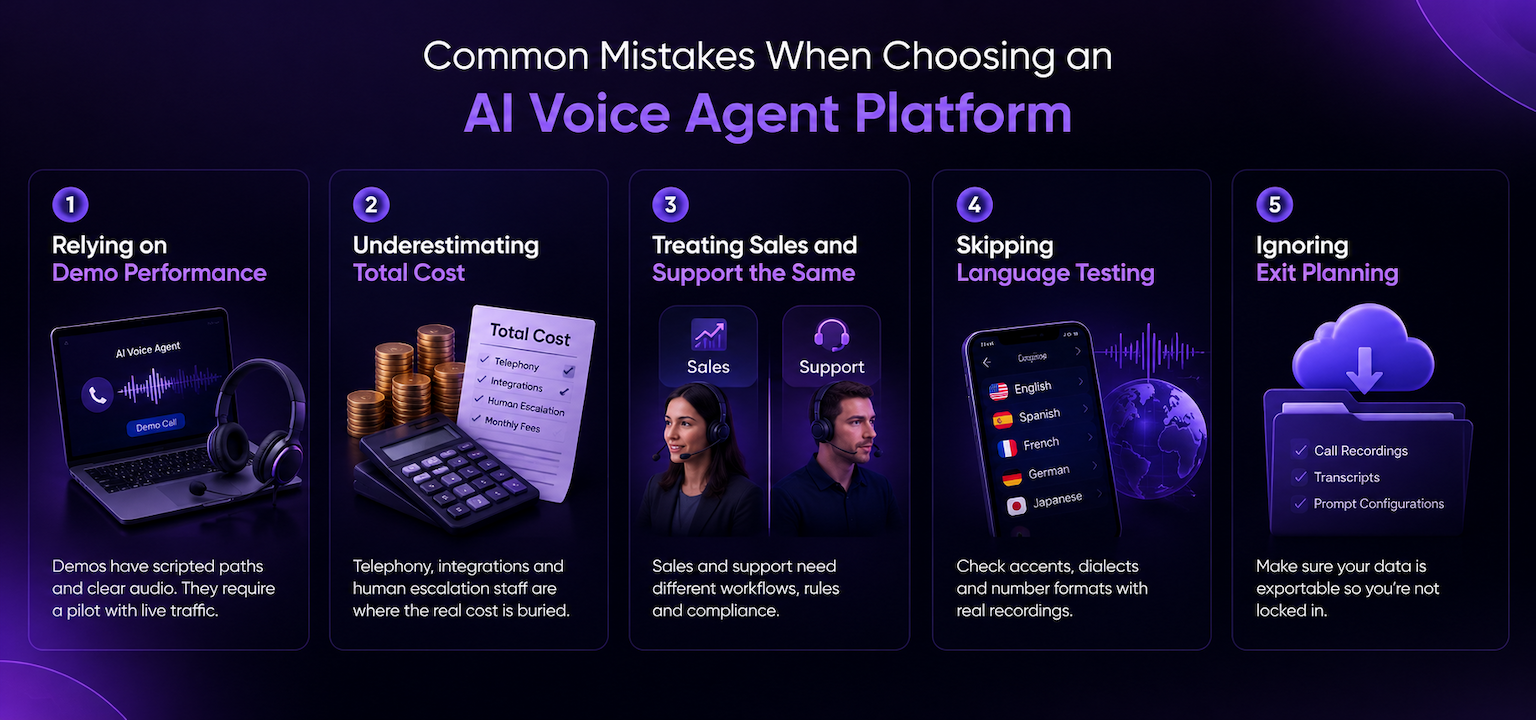
1. Relying on demo performance
Demos follow scripted paths with clean audio. Production calls bring surprises, interruptions and background noise, so run a pilot with live traffic.
2. Underestimating total cost
The real cost is often hidden in telephony, integrations and staff for human escalations, not the per-minute rate. Ask for a detailed estimate at your expected volume before you sign.
3. Treating sales and support as the same problem
Sales voice agents need call frequency limits, consent handling and outbound compliance. Support agents need accurate account lookups and clean handoffs. A vendor's strength in one area does not guarantee strength in the other.
4. Skipping language testing
Many vendors list dozens of languages, but quality depends on accent, dialect, and number and date formatting. Teams serving diverse markets should evaluate multilingual performance with real recordings and check pronunciation controls such as the W3C Speech Synthesis Markup Language (SSML) where supported.
5. Ignoring exit planning
Make sure call recordings, transcripts and prompt configurations can be exported, so you do not have to rebuild from scratch if you change vendors later.
Advice for Business Buyers
Start with the use case, then narrow the list. The right answer depends on whether you need a specialist for accuracy-critical workflows, a developer toolkit or an enterprise suite. Look for verified production references, transparent total cost, tested language performance and clear compliance documentation.
1. Measure on your own data
Vendor benchmarks rarely match another company's call mix. Test containment, escalation quality and handling time on recordings from your own lines. A time-boxed pilot with defined success measures often tells you more than reference calls.
2. Prioritize what matters for support
For AI voice agents for customer support, focus on accurate account lookups, smooth handoffs to humans and measurable resolution rates rather than novelty features.
3. Validate references directly
Ask vendors for references in your industry and region, and speak to them. Review minimum commitments, data retention and termination terms before signing.
4. Ask about configuration limits
Ask what you can configure yourself and what requires professional services. If you rely on proprietary systems, custom scripts or specialized logic, custom AI voice agent development may be a better fit than an off-the-shelf configuration.
5. Revisit the decision annually
Models, pricing and regulations change, and so can platform fit. Review your choice once a year.
Conclusion
There is no single best platform. The right choice depends on your risk tolerance, existing systems and call mix. Developer-first tools such as Vapi, Retell AI and Bland AI need engineering time but give you control, while enterprise suites such as PolyAI and RingCentral reduce deployment effort. Maica focuses on multilingual and calculation-aware workflows, and ElevenLabs is known for voice quality.
Before deciding, teams evaluating AI voice agent platforms should shortlist two or three vendors, test them on live calls and compare total cost. Use this guide as a scorecard, and revisit it as pricing and capabilities change.
Frequently Asked Questions
What are AI voice agent platforms?
An AI voice agent platform is software that lets businesses deploy AI-powered voice agents to handle phone calls for customer support, sales, appointment booking and more. It combines speech recognition, language models and telephony into one system that can hold natural conversations with callers.
How do I choose the best AI voice agent platform for my business?
Start with your use case and test with your own call recordings, not vendor demos. Compare vendors on five dimensions: latency, integrations, compliance and language support, total pricing, and documented outcomes. Shortlist two or three platforms and run a pilot with clear success metrics before committing.
How much do AI voice agent platforms cost?
Prices vary widely by model. Usage-based platforms focused on voice quality usually charge per conversation minute, starting at around $0.08 to $0.10 per minute. Developer toolkits add a platform fee on top of the costs of each connected provider. Platforms such as Maica and PolyAI use custom pricing with no public rate card.
What is the difference between enterprise AI voice agents and developer toolkits?
Enterprise platforms such as RingCentral and PolyAI include contact center integration, compliance controls and managed deployments as standard. Developer toolkits such as Vapi, Retell AI and Bland AI give engineering teams more control over speech, language model and telephony providers, but require more technical work to set up and maintain.
Which platform is best for multilingual AI voice agents?
Maica and ElevenLabs both focus on language coverage. Maica specializes in accurate, calculation-sensitive workflows across languages, while ElevenLabs is known for natural-sounding speech in a wide range of languages. Test each target language with native speakers before committing, because published language counts do not guarantee quality.
About the author

Deepak Dutta
Content Strategist
Deepak Dutta is a tech-focused content strategist and writer with 9+ years of experience crafting content for emerging technologies and digital products. With deep expertise in Blockchain, Web3, AI, Mobile apps, Web apps and Game development, he creates engaging, SEO-focused content that simplifies complex ideas, strengthens brand authority, and connects technology companies with their target audience.