AI Voice Agents for Healthcare: Patient Intake, Scheduling and Reminders
- By Deepak Dutta
- 11 min read
Table of Contents
Key Takeaways
- AI voice agents for healthcare automate routine calls for intake, scheduling, reminders, and after-hours support.
- Patient intake automation can collect registration details and reduce repetitive front-desk work.
- AI appointment scheduling helps clinics fill slots, manage cancellations, and reduce phone tag.
- Automated reminder calls can improve attendance and give patients an easy way to reschedule.
- Healthcare voice AI must include consent, data minimization, audit trails, and human escalation.
- Start with one workflow, measure results, and expand only after quality and compliance are proven.
Introduction
Front desks in medical practices deal with a constant flow of contacts, including requests for prescription refills, questions about insurance, requests to reschedule appointments, and registrations for new patients. Staff members are busy with check-in, so calls are missed, patients are put on hold, and appointment slots are not filled. Missed appointments and last-minute cancellations add to the stress, while administrative duties take teams away from patient care.
Many health systems are testing AI voice agents for healthcare to automate repetitive phone tasks like intake, booking and reminders. When used correctly, they reduce wait times and free staff up to give individual attention to patients who need it. They are not a substitute for clinical judgment. This guide offers a complete rundown of voice AI's role, how to deploy the technology safely, and the qualities to consider when choosing a platform.
What Are AI Voice Agents for Healthcare?
Software systems that use speech recognition, language models and speech synthesis to answer and make phone calls are known as healthcare AI voice agents. Unlike older phone menus where the caller is forced to choose numbers, they can have natural conversations, understand intent and carry out preprogrammed tasks. Practices usually combine them with scheduling, EHR and CRM systems so that every contact ends with a recorded outcome.
Healthcare Voice AI and the AI Receptionist Role
Healthcare voice AI uses conversational AI in clinical and administrative phone workflows. Patients also reach practices through chat, text and patient portals, but many practices still rely on the phone as the primary mode of communication. The WHO's global strategy on digital health encourages responsible use of digital health tools, emphasizing equity and safety.
An AI medical receptionist performs the routine work at the front desk, following predictable rules. AI receptionists in healthcare can greet callers, verify basic information, schedule appointments, respond to administrative questions, and route sensitive information to staff. They follow established protocols and practice policies and transfer the call when the caller needs clinical input, empathy or judgment.
Patient Intake: Automate Registration and Pre-Visit Work
AI patient intake shifts routine data collection from the front desk to a short phone call before the appointment. Instead of check-in clipboards and a list of questions, the agent pre-collects demographics, visit reasons and preferences. When automated patient intake is done right, it cuts down on transcription errors and waiting room time, and staff can review any anomalies.
1. Insurance Verification and Pre-Visit Checks
Automating the patient intake process can collect insurance information, confirm plan and member information, and help identify missing documents to be resolved by staff. Some platforms have integrated eligibility tools; however, the functionality of these platforms varies by payer and vendor. Verification should be considered a first-pass collection step and still needs to be verified by staff before billing.
2. Symptom Pre-Screening Boundaries
Agents can ask why the patient is attending or whether the symptoms are new, using questions that are scripted and approved by the practice. The agent must not interpret the answers, suggest causes or advise treatment. If the caller describes urgent symptoms, the agent should stop the workflow immediately and escalate the situation.
3. EHR and CRM Handoff
Collected data is only useful if it lands in the right place. Look for a structured handoff into your EHR or CRM with elements mapped to your forms, a call summary, and a clear audit trail. Staff members should have the ability to review and correct entries before they are placed in the patient record. Decide beforehand which fields are mandatory and which are optional, and who will be responsible for follow-up when information is missing.
AI Appointment Scheduling for Healthcare
Patients can call to schedule, change, or cancel appointments 24/7. Automated medical appointment scheduling follows your rules, such as buffer times, provider availability, and visit type. This cuts down on phone calls and relieves staff of repetitive booking calls, while exceptions are still handled case by case. This workflow relies more on rules than on conversational intelligence.
1. Bookings, Cancellations and Rescheduling
AI appointment scheduling for clinics works best when the agent sees actual availability. It can offer open slots, verify the details by repeating them, and send a confirmation. For rescheduling and cancellations, it can release the old slot and offer the next best option, helping the practice fill gaps that would otherwise be left empty.
2. Calendar and EHR Integration
Scheduling reliability is determined by integration. Two-way sync with your calendar or EHR avoids double bookings and preserves provider templates. Ask vendors what systems they connect to, whether writes happen in real time and what happens if the connection drops. It is important to have a safe backup plan, such as leaving a message for staff, and patients also benefit from a text or email confirmation after the call.
AI Appointment Reminders and Patient Follow-Up
AI appointment reminders reach patients by voice, which can be useful for patients who prefer talking or miss texts. Automated patient reminder calls can confirm attendance, provide rescheduling options and give preparation instructions (e.g. arrival time or what to bring). Because patients can respond immediately, the practice can promptly fill the slot when cancellations occur.
1. No-Show Reduction
Reminders are a well-researched tool to improve attendance. A Cochrane review found that attendance was better with text-message reminders than with no reminder. Voice outreach may provide similar benefits, but practices should evaluate the results with their own patient population. Combine reminders with an easy way to reschedule; patients who can change their appointments with a phone call are less likely to miss them.
2. Follow-Up Calls and Staff Escalation
AI patient follow-up calls can confirm that a patient received instructions, remind them about lab work or referrals or ask them to schedule a follow-up appointment. They should not judge recovery or interpret symptoms. Create triggers that direct a call to the appropriate personnel, such as a request for a nurse, a billing issue or any mention of worsening symptoms. If follow-up outreach involves telehealth visits, review current coverage and communication rules in the CMS Medicare telehealth guidance.
Healthcare Call Automation Beyond Business Hours
The most obvious time to automate healthcare calls is after hours, when staff are scarce and voicemails pile up. Medical offices can use an AI answering service to handle patient calls after hours. The service can take messages, schedule appointments for the following day and answer frequently asked questions about location, hours and preparation. Patients get a response, not a recording, and call notes are well organized for the morning staff.
1. Call Routing and Urgent-Symptom Escalation
Routing rules decide who handles each call. Billing questions can be directed to the billing staff, clinical questions to a nurse line, and new patient requests to scheduling. If the caller is experiencing urgent symptoms, the agent should immediately refer them to emergency services or the practice's on-call process and not proceed with the routine script. These are the paths with the highest stakes, so test them often.
2. Multilingual AI Voice Agents
Multilingual AI voice agents can serve patients in their preferred language, improving access and reducing the need for ad hoc interpretation. Ask vendors how performance was tested in the languages your patients actually speak, because quality depends on the language and the accent. Keep a pathway to qualified human interpreters for clinical conversations. Document language coverage in patient communications so that patients know what to expect.
Compliance, Privacy, and Safe Escalation
Voice AI handles protected health information, so compliance design is a priority. HIPAA-aligned handling applies the safeguards described in the HHS HIPAA Security Rule guidance to audit logging, encryption, and access control. Covered entities also typically need business associate agreements with vendors who process patient data. Work with your compliance officer or counsel to make sure you meet the requirements, and treat compliance as a design requirement, not an afterthought.
1. Consent, Recordings, and Data Minimization
Let callers know they're speaking to an AI and that the call is being recorded, and comply with state recording-consent laws. Set retention limits for recordings and transcripts and only collect the information needed for the task. The HHS Office for Civil Rights privacy guidance explains how the Privacy Rule governs the use and disclosure of patient information. Check each vendor's privacy policy; Maica's privacy practices are available on its website.
2. Human Escalation and Clear Limits
AI must not diagnose, clinically triage, or replace emergency care. Develop clear guidelines: urgent symptoms trigger emergency instructions, distress or confusion triggers a handoff, and any caller can ask to speak to a person. Keep track of each escalation and review samples regularly so the rules improve over time. Document these constraints in staff training and patient protocols.
The information in this article is for general informational purposes only and is not intended as legal, compliance or medical advice. Healthcare organizations should consult with qualified legal and compliance professionals before implementing AI voice technology.
How to Implement AI Voice Agents in a Medical Practice
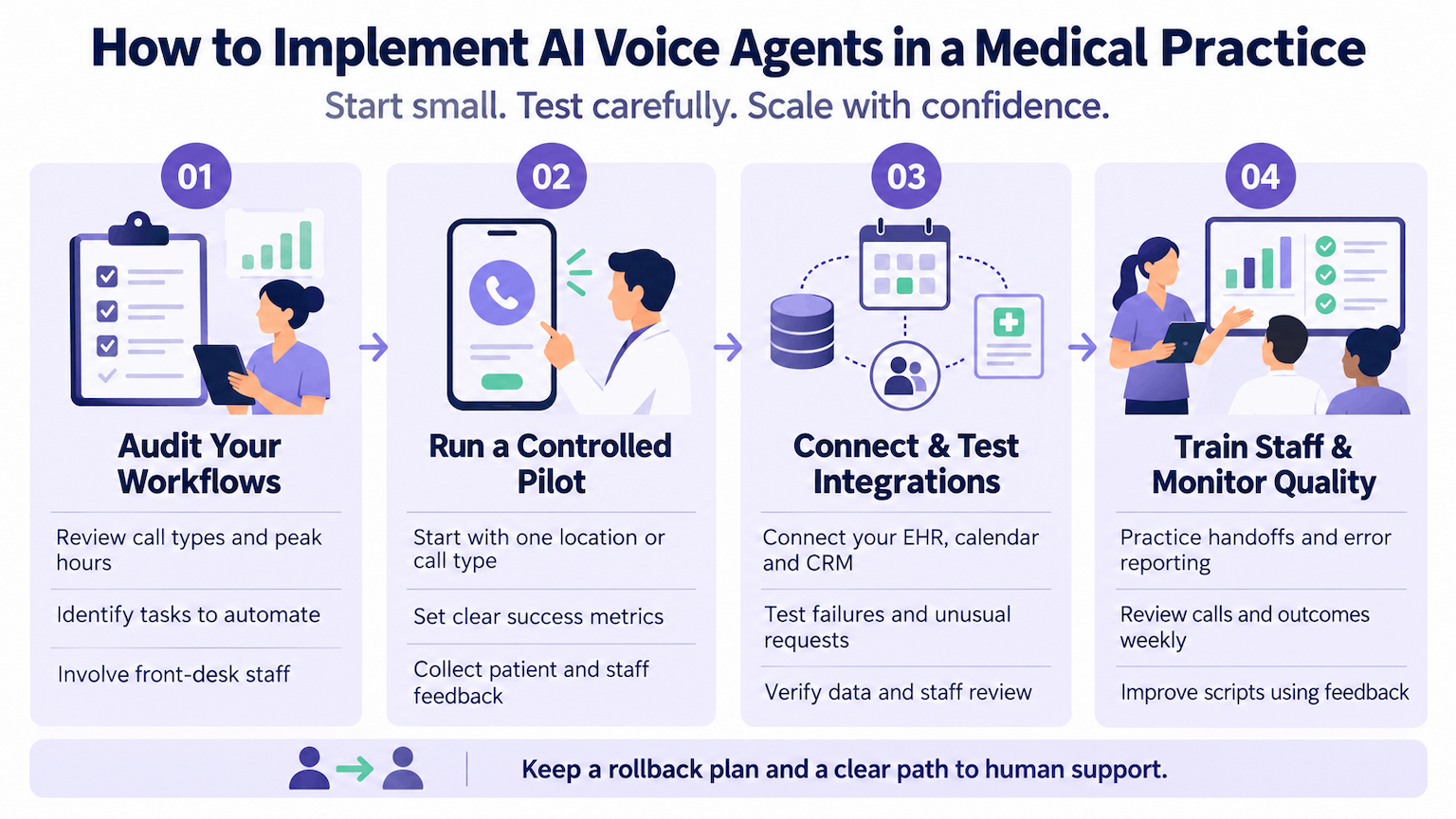
Phased roll-outs are less risky and help build staff confidence. Have a rollback plan in place so calls can get back to staff quickly if performance suffers. Begin with a narrow scope and scale only as long as quality holds.
1. Start With a Workflow Audit
Track call volume by type and peak hour, and where staff spend most of their time. Determine which calls can be fully automated, which need verification, and which should always be answered by a person. Bring in the front-desk team early, since they know which calls are most likely to be difficult.
2. Run a Controlled Pilot
Start with one location or call type, such as appointment confirmations, for a few weeks. A targeted pilot teaches you more than a broad launch that is difficult to track. Before the launch, define the metrics you will use to measure success, including answer rate, completed bookings, escalation rate and patient feedback.
3. Connect and Test Integrations
Integrate the voice agent with your EHR, calendar and CRM, and test it with real-life scenarios like dropped connections and unusual requests from callers. Make sure data lands in the right fields before it enters the patient record, and that staff can review and correct any errors.
4. Train Staff and Monitor Quality
Train staff on the agent's responsibilities, handoff procedures, and how to report errors. Review recordings or transcripts weekly, track no-show and escalation rates, and use patient feedback to improve routing rules and scripts.
How to Choose a Healthcare Voice AI Platform
Your platform choice will affect safety, staff workload and patient experience for years to come. List your must-haves before the first demo so you can evaluate each vendor consistently on your actual workflows, not on polished demos.
1. Integrations and Technical Fit
Verify integrations with your CRM, calendar and EHR. Do data writes happen in real time? What happens during an outage? Does the platform work with your existing patient-communication workflows?
2. Accuracy and Multilingual Support
Ask for accuracy results on real healthcare calls with different accents, background noise and common patient phrasing. Make sure the platform supports the languages your patients actually speak, and ask how it handles interpretation for clinical conversations.
3. Security, Compliance, and Escalation
Ask for a business associate agreement and security documentation, such as SOC 2 or ISO 27001 reports. Assess the escalation design, how easily callers can reach a person, and how urgent symptoms are handled.
4. Reporting, Support, and Total Cost
Review the reporting you get back, including call outcomes, bookings, escalations and failed handoffs. Consider the total cost, including internal staff time, usage fees and implementation, instead of looking only at headline prices.
One option to consider when shortlisting vendors is Maica, an AI voice calling platform that supports healthcare use cases. As with any provider, check with the vendor on its current capabilities, certifications and compliance documentation.
Explore AI Voice Agents for Your Practice
Maica's healthcare voice AI platform allows practices to automate patient intake, appointment scheduling, reminders and after-hours call management with staff oversight. Check out Maica for Healthcare to discover how its voice agents can streamline your patient-communication workflows.
Concluding Note
AI voice agents for healthcare can take the burden of repetitive contacts off busy teams without taking people out of care. Intake automation captures registration details before the visit, scheduling keeps the calendar full and reminders help patients arrive on time or reschedule early. After-hours coverage means callers are never left with only a voicemail.
All of this needs guardrails. AI must never diagnose or substitute for emergency care, and consent, data minimization, HIPAA-aligned safeguards and explicit escalation rules protect both the practice and the patient. Begin with a single workflow, evaluate the results, and expand carefully. The most sustainable gains in efficiency and access come from treating voice AI as an assistive tool, with quality reviews and staff oversight.
Frequently Asked Questions
What do AI voice agents for healthcare do?
They answer and place calls to help with patient intake, appointment scheduling, reminders, follow-ups, after-hours coverage, and call routing. They handle routine administrative matters and refer clinical or complex issues to staff.
Can an AI medical receptionist replace front-desk staff?
No. An AI receptionist can take the burden of repetitive inquiries off the staff, but it cannot replace human judgment, empathy, clinical decision-making or emergency care.
How do AI appointment reminders reduce no-shows?
Reminder calls help to confirm attendance, give patients the opportunity to reschedule and help practices identify cancellations in time to rebook the openings.
Are AI voice agents HIPAA compliant?
A platform can support HIPAA-compliant workflows, but that does not make the platform itself HIPAA compliant; compliance depends on how the platform is configured and used. Practices should check with their compliance team on audit logging, consent processes, data handling practices, business associate agreements and security controls.
Can AI voice agents handle after-hours patient calls?
Yes. They can take messages, book appointments for the next day, answer routine questions and route urgent issues according to the practice's escalation process.
What should practices automate first?
Start with a high-volume, low-risk workflow such as routine rescheduling, appointment confirmations, or pre-visit intake. Expand the pilot once quality, compliance and patient-experience targets are met.
About the author

Deepak Dutta
Content Strategist
Deepak Dutta is a tech-focused content strategist and writer with 9+ years of experience crafting content for emerging technologies and digital products. With deep expertise in Blockchain, Web3, AI, Mobile apps, Web apps and Game development, he creates engaging, SEO-focused content that simplifies complex ideas, strengthens brand authority, and connects technology companies with their target audience.