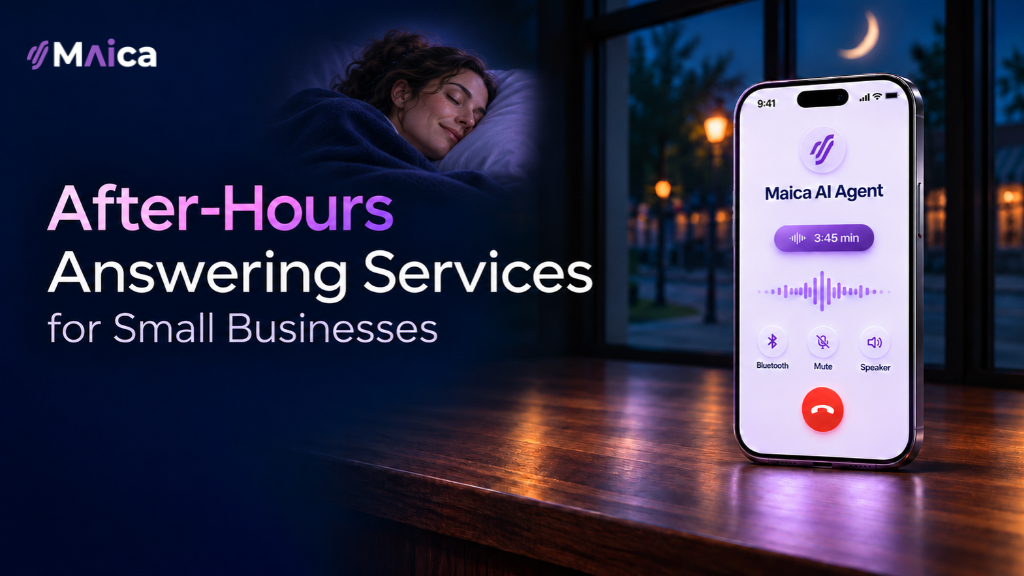
After-Hours Answering Services for Small Businesses
- By Deepak Dutta
- 9 min read
Table of Contents
Key Takeaways
- CallRail found 78% of consumers abandon a business after an unanswered call.
- Only 42% of callers say they leave voicemail when nobody answers.
- Voicemail is enough only under roughly ten calls monthly and nothing urgent.
- Live services bring judgment and empathy but cannot book or update systems.
- AI costs far less and books instantly, yet needs escalation for emergencies.
- AI usually beats live somewhere around 80 to 100 calls monthly.
Introduction
Most small businesses don't lose customers at noon. They lose them at 7 p.m., on Saturday morning, or in the middle of a lunch rush when nobody can get to the phone. And callers don't wait around: in a 2025 CallRail survey, 78% of consumers said they'd abandoned a business after an unanswered call. Each of those callers has a problem and a budget, and the next business on their list is one tap away.
Fixing that starts with picking the right after-hours answering service for the way your calls actually come in. This guide covers what these services are, what they cost, when plain voicemail is genuinely enough, and how live, AI, and hybrid coverage compare. You'll also find the break-even point and the contract questions that protect your budget. Think of after-hours coverage as a revenue decision first and a phone decision second. Whether you get five calls a month or fifty, there's a sensible option.
What Is an After-Hours Answering Service?
An after-hours call answering service picks up when your team can't, then takes a message, answers common questions, or sends urgent issues straight to you. The main models differ in who answers and what they can do once they pick up.
Coverage windows differ too. Some services answer only overnight, while others also cover weekends, holidays, and lunch breaks. Work out your gap first, say 6 p.m. to 8 a.m. plus weekends, so you don't pay for hours you don't need.
1. Live Answering
A trained human answers using a script you supply. Live agents are strong on empathy and judgment, but they usually can't touch your calendar or software.
2. AI Answering
A voice agent answers instantly, books appointments, handles FAQs, and logs every call. It's cheap at volume, though it can stumble with upset or ambiguous callers.
3. Hybrid Answering
AI takes the routine calls and hands emergencies or emotional conversations to a person. For many small businesses, that's the practical middle ground.
The Real Cost of Missed After-Hours Calls
Nobody agrees on exactly how many calls go unanswered. A widely quoted study from 2016 of 85 small businesses put it at 62% during business hours, but that sample is small and old, and newer vendor estimates run closer to 28–35%.
What's clearer is how callers react. In the CallRail survey of 1,000 US consumers, 78% said they'd abandoned a business after an unanswered call, and 82% said they'd call a competitor. One AI voice vendor's aggregated call data also suggests 30–42% of small business calls arrive outside standard hours, with home services and healthcare at the high end.
Here's what that can cost. Picture an HVAC contractor who gets 40 after-hours calls a month, half of them real leads. If a quarter of those leads would have booked a $400 job, missed call revenue loss comes to about $2K a month, or $24K a year. The numbers are made up for illustration, but the math holds for most service businesses.
Emergency trades, medical practices, and legal intake lose the most, because people with urgent problems don't wait until morning. An answering service for small business owners only has to win back a few jobs to pay for itself.
Voicemail vs Answering Service: When Voicemail Is Enough
Voicemail is a legitimate choice, and it's the right one more often than vendors admit. If you get fewer than about 10 after-hours calls a month and most can wait, a clear greeting and a next-morning callback routine will do the job. At that volume, it can anchor your small business phone coverage on its own.
The catch is that callers often skip it. In the CallRail survey, only 42% said they leave a voicemail when nobody answers, and that's what people say they do, not necessarily what they do. Plenty of callers never reach your inbox.
So voicemail works when calls are rare, inquiries can wait, and nobody's facing an emergency. It falls short when calls involve urgent problems, high-value jobs, or new customers comparing options. In the voicemail vs answering service decision, the number that matters is what one lost call is worth, not the monthly bill. If a single booked customer is worth more than a year of voicemail savings, voicemail is the expensive option, and that's a call only your own numbers can settle.
Live Answering Service: Human Voice, Human Limits
People handle emergencies, upset callers, and judgment calls that no script covers. That's why a live answering service still makes sense for a funeral home, a medical practice, or an emergency plumber.
The limits are practical. Operators often can't see your calendar, book into your scheduling software, or update your CRM, so you get a message you still have to process in the morning. Handoffs add delay, and quality can vary from shift to shift. Ask how operators learn your business and how messages reach you; a text summary within minutes beats an email batch at dawn.
Expect roughly $0.75 to $1.75 per minute, or $150 to $600 a month, according to Plura's pricing breakdown. Many providers add night, weekend, and holiday surcharges, commonly 20% to 50%, which stings when every call you care about comes after hours. Good after-hours call handling depends on what happens after the call, not just on who answers it.
AI Answering Service: Cheaper, Faster, But Can It Handle Your Calls?
AI voice agents pick up on the first ring, every time, no matter how many calls land at once. They're strongest at booking appointments, answering FAQs about hours and service areas, and qualifying leads, with details written straight into your calendar or CRM. After an ad campaign or a storm, a human team can't match that.
They're weaker at calming upset callers, untangling vague requests, and anything that takes real judgment. Someone reporting a flooded basement, or a family in grief, needs a person, and a well-built setup transfers those calls instead of improvising.
Plan on roughly $29 to $300 a month, or about $0.05 to $0.50 per minute, depending on the vendor. An AI answering service usually costs a fraction of live coverage, which puts after-hours coverage within reach of solo operators. Setup matters as much as the technology: a good deployment is trained on your services, hours, price ranges, and escalation triggers, then tested before launch.
| Feature | Voicemail | Live Service | AI Service |
|---|---|---|---|
| Typical cost | Free to low | $150-$600/month | $29-$300/month |
| Answers instantly | No | Yes | Yes |
| Books appointments | No | Rarely | Yes |
| Updates CRM | No | Rarely | Yes |
| Handles emotional calls | No | Yes | Limited |
| Best fit | Under 10 calls/month | Sensitive, low volume | Routine, higher volume |
The Break-Even Point: When AI Beats Live (and When It Doesn't)
Pricing models cross over at volume. Estimates vary by vendor and average call length, but a common rule of thumb puts the crossover at roughly 80 to 100 calls a month, where a flat-rate AI plan starts beating metered human answering. Below about 30 calls a month, a small live plan can hold its own.
The fine print can change the math. Overage rates, billing increments, and night or weekend surcharges can add a lot to a headline price. A $150 plan with 50 included minutes gets pricey fast when each extra minute costs $1.50. Run your own call minutes through any answering service pricing sheet before you compare plans.
Between 30 and 80 calls, call type matters more than cost. Routine bookings favor AI, sensitive conversations favor humans, and a hybrid setup often wins in the middle. If you can't tell which side of the line you're on, a two-month test of each model on the same call mix will show you.
What to Ask Before Signing an After-Hours Contract
Before you sign, get written answers to these. They separate an honest quote from a surprise on the second invoice. A reliable after-hours call answering service won't hesitate.
- Night and weekend surcharges
- Overage rate per minute
- Billing increment (6, 30, or 60 seconds)
- Spam and robocalls charged
- CRM and calendar integration
- Escalation rules and response times
Billing increments deserve a second look. A 60-second minimum turns a 20-second spam call into a full billable minute, and rounding adds up fast if you get lots of short calls. Ask for a trial month so you can inspect a real invoice.
Ask about call recording, data handling, and cancellation terms too. Month-to-month contracts let you switch when your call patterns change, and recordings help you refine scripts and settle disputes.
Building a Coverage Plan for Your Business
Start with evidence, not guesses. Pull 60 to 90 days of phone records and sort calls by hour, length, and outcome. That audit shows your real volume, how many calls are urgent, and what each missed lead might have been worth.
Next, pick a model by volume and call type. Low volume and non-urgent calls suit voicemail, high-volume routine calls suit AI, and emergency-heavy businesses suit live or hybrid after-hours coverage. A business with mixed calls will often land on hybrid.
Then set escalation rules: what counts as an emergency, who gets called first, and what the caller hears if nobody answers. Finally, run a 10 AM callback sweep every morning. Review overnight calls, return every lead, and note which ones the system handled badly. Even the best answering service for small business needs that daily check to keep improving. Review the numbers monthly and recheck your break-even math as volume grows. Keep the plan on one page so anyone on your team can follow it.
Concluding Note
Every after-hours call is a customer, a lead, or an emergency reaching you when you can't pick up. Voicemail covers the low-volume, low-urgency end, live agents handle sensitive conversations, and AI covers routine volume at a fraction of the cost. Hybrid setups blend all three.
Let your call log, average job value, and break-even math decide, not a vendor brochure. Audit a month of calls, test one option for 30 days, and compare the results. If you'd like to see how an after-hours answering service built on voice AI would handle your calls, run a real scenario with Maica. Whatever mix you land on, the goal stays the same: a caller who reaches you at 9 p.m. should get an answer, a booking, or a clear promise of a callback.
Frequently Asked Questions
How much does after-hours call answering cost?
Live services run roughly $0.75-$1.75 per minute, or $150-$600 a month. AI services run about $29-$300 a month. Live plans often add night, weekend, and holiday surcharges, and per-minute rounding can inflate the bill.
When is AI cheaper than live answering?
A common rule of thumb puts the crossover at 80–100 calls a month for a flat-rate AI plan against metered human answering. Below about 30 calls, a small live plan can compete on cost.
Is voicemail enough for my small business?
It's defensible under roughly 10 non-urgent after-hours calls a month. CallRail's survey found only 42% of consumers say they leave a voicemail, so plenty of callers never reach your inbox.
What is the difference between live, AI, and hybrid answering?
Live puts a trained human on the line, but operators often can't book or update your CRM. AI answers instantly, books, and logs calls, but struggles with emotional or ambiguous requests. Hybrid sends routine calls to AI and escalates emergencies to people.
Can AI answering services handle emergencies?
AI can flag emergencies and transfer them to a person or on-call contact, but it shouldn't handle emotional de-escalation or complex judgment alone. Set escalation rules so urgent calls transfer with context.
About the author

Deepak Dutta
Content Strategist
Deepak Dutta is a tech-focused content strategist and writer with 9+ years of experience crafting content for emerging technologies and digital products. With deep expertise in Blockchain, Web3, AI, Mobile apps, Web apps and Game development, he creates engaging, SEO-focused content that simplifies complex ideas, strengthens brand authority, and connects technology companies with their target audience.