12 AI Voice Agent Use Cases for Sales, Support and Operations
- By Deepak Dutta
- 8 min read
Table of Contents
Key Takeaways
- Pick one high-volume, repeatable workflow first, then expand once results are proven.
- Sales agents win on speed, qualifying and booking while interest is high.
- Support agents give instant answers, clean tickets and quick escalation, every hour.
- Operations agents cut coordination work in scheduling, dispatch, tracking and internal support.
- Every use case needs a defined handoff condition before it goes live.
- Measure containment and handoff quality, not just call volume, to prove ROI.
Introduction
Sales teams are consistently using voice AI agents to reach every lead, support teams use it to pick up every call, and operations teams use it to schedule and dispatch without hiring more people. If you're sizing up AI voice agent use cases for sales next to support and operations, the real question is which workflows an agent can own and which still need a person.
Here are 12 practical use cases: four for sales, four for support and four for operations. For each one, we cover what the agent does, the result it drives and one honest limit or handoff condition, so you can see where voice AI works and where it doesn't. Examples from Anarock, Zendesk and SignalWire keep things grounded, and a short section near the end covers what agents still can't do, so you can plan with realistic expectations from the very first pilot call.
Why AI Voice Agents Fit Sales, Support, and Operations
Sales, support and operations all live on the phone, and most of their calls follow a pattern. That's where AI voice agents for business do best: volume is high, questions repeat, and how fast you answer often decides the outcome. Meticulous Research expects the global conversational AI market to reach $54.1 billion by 2031, so this is hardly a niche bet.
What counts as success differs, though. Sales wants booked meetings, support wants faster resolution, and operations wants less manual coordination. Tie the business use cases for AI voice agents to those goals and each team can judge a pilot against a number it already tracks.
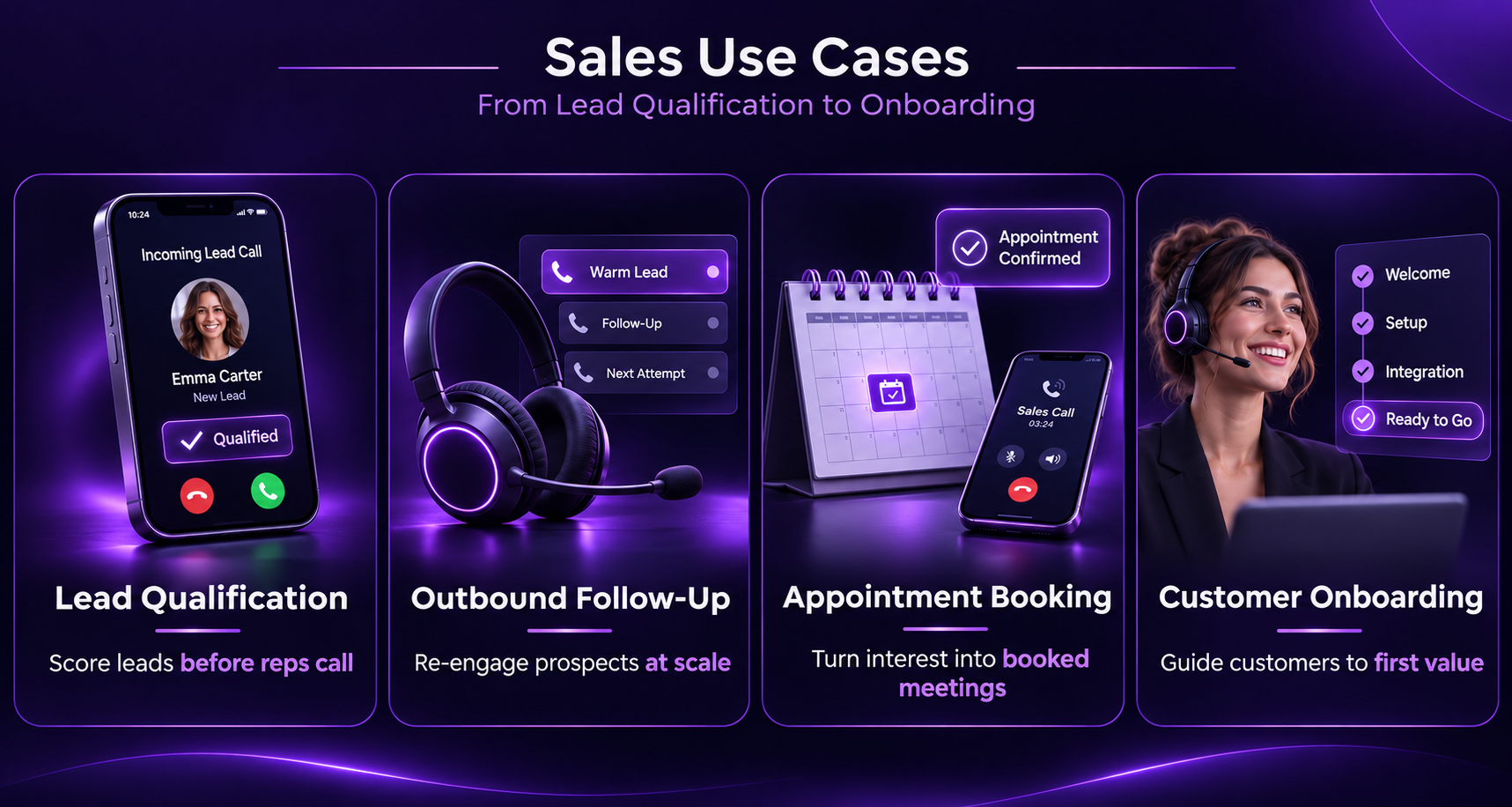
Sales Use Cases: From Lead Qualification to Onboarding
Sales is a race against the clock. Every minute you wait lowers the odds of a real conversation, and every unanswered lead is money left on the table.
1. Lead Qualification
An AI-powered lead qualification agent phones new enquiries within moments, asks about budget, timeline and need, and scores the lead before a rep sees it. With this AI voice agent for sales, reps get a short summary instead of a cold name, and your warmest prospects stop going stale. The catch is that unusual buying situations confuse it, so send those callers to a person as soon as the answers stop fitting the script.
2. Outbound Sales Follow-Up
An AI voice agent for outbound sales works through lead lists, re-engaging cold contacts and finding the ones still shopping, which makes an AI voice agent for lead follow-up realistic at volume. Anarock, an Indian real estate firm, reports 5x calling capacity and doubled agent-assisted bookings after rolling out its Genie voice agents. Outbound calling still needs consent and calling-hour compliance, and interested prospects should be transferred live to a person.
3. Appointment Booking
An AI voice agent for appointment booking picks up, checks the calendar and confirms a slot while the prospect is still interested. You get more booked demos or site visits, and fewer no-shows because the agent can call the day before. It can't handle odd constraints like multi-party meetings, so a human coordinator should take those.
4. Customer Onboarding
An AI voice agent for customer onboarding walks new customers through setup, collects missing details and answers first-week questions before frustration sets in. Customers reach value sooner, and fewer drift away because a basic step confused them. Custom configuration or contract changes still need a specialist, so hand off when the request leaves the standard path.
Support Use Cases: From FAQs to Ticket Management
Support use cases protect the customer experience first and the cost base second, so each one below pairs automation with a clear route to a human.
5. 24/7 FAQ Handling
An AI voice agent for FAQs answers routine questions about hours, policies and account basics at any hour, which gives you 24/7 AI customer support without a night shift. Queues shrink because this automated phone support soaks up the repetitive questions that make up most inbound volume. It's only as good as your knowledge base, so missing or outdated content should trigger escalation, not a guess.
6. Ticket Creation and Routing
An AI voice agent for ticket management captures the issue, opens a ticket in your helpdesk and routes it with a transcript attached, so nobody has to ask the caller to repeat themselves. Zendesk builds its voice agents around this pattern, with secure caller checks and support for more than 50 languages. Misrouted tickets still happen, so review routing accuracy every week.
7. Order Tracking and Status Updates
An AI customer service voice agent looks up an order, shipment or claim and reads the status back with no queue. Fewer where-is-my-order calls leaves your team free for problems that need judgment. It can't fix a lost shipment or approve a refund exception, so those go to a person.
8. After-Hours Overflow Support
When the team is offline or volume spikes, an AI call center agent takes the overflow, resolves what it can and logs the rest for the morning. The demand is real: Anarock says roughly 30% of its customer conversations happen outside working hours, when a voicemail box would otherwise swallow the lead. Urgent complaints, like outages or safety concerns, should page an on-call person instead of waiting.
Operations Use Cases: From Scheduling to Internal Support
An AI voice agent for operations takes over the coordination work that quietly eats staff hours every week.
9. Appointment Scheduling and Reminders
An AI voice agent for appointment scheduling books, moves and cancels slots by phone, then calls with reminders before the visit. As an AI receptionist for businesses, it keeps the calendar full and frees the front desk for the people standing in front of it. Complex multi-resource scheduling, such as a room plus two specialists, still needs a human check before confirmation.
10. Dispatch and Field Coordination
An AI voice agent for dispatch qualifies the job, checks technician availability and books the visit, even when nobody's in the office. In SignalWire's home services example, urgent after-hours calls escalate to a human dispatcher with the full call context attached. What counts as a real emergency, like a gas leak, should follow rules your team sets.
11. Order Tracking for Operations
An AI voice agent for order tracking calls suppliers, drivers or customers to confirm delivery windows and logs each update in your system of record. This voice automation for business operations replaces hours of manual chasing with a consistent, auditable process. Damaged or missing goods need a person to decide the fix and contact the customer.
12. Internal Support and HR Queries
An AI voice agent for internal support answers employee questions on leave balances, payroll dates and basic IT issues, and can help schedule interviews. Maica builds AI voice assistants for businesses that take these repetitive requests off HR and IT queues. Grievances, health disclosures and other sensitive matters belong with a trained person, so build a clear transfer path from the first call.
How to Choose Which Use Case to Start With
Start with one high-volume, repeatable workflow, like FAQs, appointment reminders or lead qualification. Track containment, meaning the share of calls the agent finishes without a handoff, along with the quality of the handoffs that remain. Larger buyers should also check which enterprise AI voice solutions fit their industry, security and integration needs before taking a pilot beyond one team or location.
Sector matters too. Financial services teams often begin with payment reminders and KYC follow-ups, and Bajaj Finserv notes that voice AI suits India's linguistic diversity and round-the-clock service needs. Compare the platform's AI voice agent applications against your own call types, pick from the voice AI use cases above, and expand only once the pilot proves ROI.
What AI Voice Agents Cannot Do (Yet)
Voice agents are still weak at complex negotiations, emotional de-escalation, regulated decisions and emergencies. Distressed callers need empathy, and decisions with legal or financial consequences need an accountable human. Build these in as automatic handoff triggers across all your conversational AI use cases, and test the handoff as hard as the automation.
Cost isn't the whole story either. ElevenLabs' research notes that traditional call centers typically cost $5 to $25 per interaction, but cheap calls don't help if a frustrated customer can't reach a person. The best deployments treat savings as a side effect of faster resolution, not the goal.
Concluding Note
AI voice agents earn their place when they take over repeatable calls and pass the rest to people cleanly. Across sales, support and operations, the 12 use cases above follow one pattern: a narrow workflow, a measurable outcome and a clear limit that triggers a human handoff.
If you're shortlisting AI voice agent use cases for sales, start where leads wait longest, like qualification or follow-up, then extend into support and operations as results hold. Pilot one workflow, review the handoffs every week, and let the data decide what the agent owns next, so each expansion rests on evidence and customers feel the service getting steadily better. Honest limits, clear handoffs and one proven workflow at a time will take you further than a big-bang rollout.
Frequently Asked Questions
What are the main use cases for AI voice agents?
This guide covers 12: lead qualification, outbound follow-up, booking and onboarding for sales; FAQs, ticket routing, order tracking and overflow for support; scheduling, dispatch, order tracking and internal support for operations. Start with one high-volume workflow.
How do AI voice agents improve customer service?
They answer routine questions instantly at any hour and pass complex issues to the right person with full context. Callers wait less, and your team spends its time on problems that need judgment.
How are AI voice agents different from traditional call centers?
Traditional centers depend on staffing hours and typically cost $5 to $25 per interaction. Voice agents handle routine calls around the clock, scale without extra headcount and escalate the hard ones to humans.
Can AI voice agents handle appointment scheduling?
Yes. They book, move and cancel appointments by phone and place reminder calls. Complex multi-resource scheduling still needs human review.
What should I look for in an AI voice agent platform?
Check accuracy on your own call types, integration with your helpdesk or CRM, handoff quality, language support and security documentation. Ask for a pilot that measures containment on real calls before you commit to volume.
How do I measure AI voice agent ROI?
Track containment rate, handoff quality, resolution time and cost per resolved interaction, and compare them with your baseline. Savings without good resolution quality don't count.
What are the biggest limitations of AI voice agents today?
Complex negotiations, emotional de-escalation, regulated decisions and emergencies still need people. Build automatic handoff triggers for each.
Which industries benefit most from AI voice agents?
Any business with high call volume and repeatable workflows, including real estate, healthcare, financial services, home services, e-commerce, recruitment and hospitality.
How long does it take to deploy an AI voice agent?
It depends on how many systems you need to integrate. A single-workflow pilot is usually the quickest route, and you can add workflows once it proves its value.
What is containment rate and why does it matter?
It's the share of calls the agent finishes without escalating to a human. It's one of the most useful ROI measures, because every escalation adds human handling time.
About the author

Deepak Dutta
Content Strategist
Deepak Dutta is a tech-focused content strategist and writer with 9+ years of experience crafting content for emerging technologies and digital products. With deep expertise in Blockchain, Web3, AI, Mobile apps, Web apps and Game development, he creates engaging, SEO-focused content that simplifies complex ideas, strengthens brand authority, and connects technology companies with their target audience.