How Much Does an AI Voice Agent Cost? Pricing Factors and ROI
- By Deepak Dutta
- 10 min read
Table of Contents
Key Takeaways
- Advertised rates are misleading because blended costs often reach $0.50–$1.50 per minute.
- Three pricing models exist: usage-based, subscription, and hybrid plans each suit different call volumes.
- Hidden costs shape first-year budgets since setup, integrations, overages, and support add significantly to total spend.
- Human versus AI costs depend on containment because every escalation reduces part of the cost advantage.
- ROI is a ratio, not a rate, calculated as human costs avoided divided by total AI costs.
- Containment rate is the key metric since, at 50% containment, the effective AI cost per resolution doubles.
Introduction
Every vendor quotes a tidy number, and few invoices match it. The real AI voice agent cost depends on how you're billed, how much your customers talk, what the agent plugs into, and how often it resolves a call without a human. A $0.07 per-minute headline can easily turn into $0.50 or more once telephony, models, and compliance get added.
This guide treats pricing as a total-cost-of-ownership question. We'll cover pricing models, cost drivers, hidden fees, a fully loaded comparison with human agents, and an ROI formula grounded in real deployments. The figures are benchmarks, not quotes, and they move fast.
Whether you run operations, finance, or a growing startup, you need a model you can defend in a budget review, not a single number that falls apart when procurement asks what's included. Treat these figures as direction and check every one against live proposals. We'll also point out where the cost advantage disappears.
AI Voice Agent Pricing Models: Usage-Based, Subscription, and Hybrid
AI voice agent pricing comes in three structures, and the right one depends on how predictable your call volume is. Published usage rates run from roughly $0.04 to $0.40 per minute. Building-block benchmarks show the floor: Mistral lists $0.04 per minute, Fish Audio $0.06, and AssemblyAI $0.075. Aircall spans $0.05–$1.00 per minute, and Plura charges $0.35–$0.85 per conversation.
Each Model Rewards a Different Volume Pattern
| Model | How it bills | Best fit | Main risk |
|---|---|---|---|
| Usage-based | Per minute or conversation | Variable or seasonal volume | Long calls inflate bills |
| Subscription | Fixed fee, bundled minutes | Steady, predictable volume | Caps and overages |
| Hybrid | Base fee plus metered usage | Growing or enterprise teams | Complex invoices |
Published rates only tell part of the story. One 2026 benchmark review found business-grade blended rates of $0.50–$1.50 per minute once models, voice quality, and telephony are combined. That gap is why voice AI platform pricing is best compared on cost per resolved call. For rate detail, see Maica's guidance on AI voice agent cost per minute.
Usage-based billing suits unpredictable or seasonal volume, but long calls hurt. Subscriptions reward steady volume until a cap triggers overage fees. Hybrids, a base platform fee plus metered usage, balance the two and are common in larger deployments. Whichever you pick, ask what counts as a billable minute, because ringing, holding, and transfers are often treated differently.
What Drives AI Voice Agent Cost: Seven Pricing Factors
Seven factors explain most of the gap between a $0.07 quote and a $0.50 bill. Once you understand these AI voice agent pricing factors, you can negotiate scope instead of haggling over rate. The factors also feed each other: complex integrations usually come with compliance requirements and heavier support. That's why modular quotes beat bundled ones.
Seven Drivers Shape the Final Invoice
- Volume
- Model complexity
- Integrations
- Telephony
- Compliance
- Feature depth
- Support level
Volume sets your tier and discount. Model complexity changes inference spend, since premium voices and larger models raise AI voice agent cost per minute. Integrations with CRM, scheduling, and payment systems add build and maintenance effort. Telephony adds carrier minutes and number rental. Compliance needs such as call recording, consent, and data residency bring extra features and audit work. Feature depth, including analytics and multilingual support, pushes you into higher tiers, and support level sets response times. Gartner notes that conversational AI must be continuously maintained, with integration estimated at $1,000–$1,500 per agent. Ask vendors which factors are bundled and which are metered, then request quotes at three volume levels.
The Hidden Costs Most Buyers Miss
The advertised rate usually leaves out the items that decide your first-year budget. Setup fees run from $2,500 for a templated deployment to $250K for a complex enterprise build. Ask for the AI voice agent setup cost as its own line item. Otherwise, a low rate can quietly hide expensive extras.
Six Line Items Routinely Surprise Buyers
Overages show up when usage exceeds bundled minutes, and premium features like custom voice cloning or advanced analytics are often upsells. Integration work is the next surprise: AI voice agent implementation cost grows with every system the agent has to read from or write to. Pass-through charges for models and telephony can sit outside the platform fee, so AI voice bot pricing quotes deserve a line-by-line read. Support packages add recurring fees, and you should budget for ongoing tuning, because prompts, call flows, and knowledge bases need updates as your business changes. Enterprise buyers also tend to underestimate escalations and rework, which is why one enterprise pricing guide argues cost per minute is the wrong lead metric.
AI Voice Agent vs Human Agent Cost: The Real Comparison
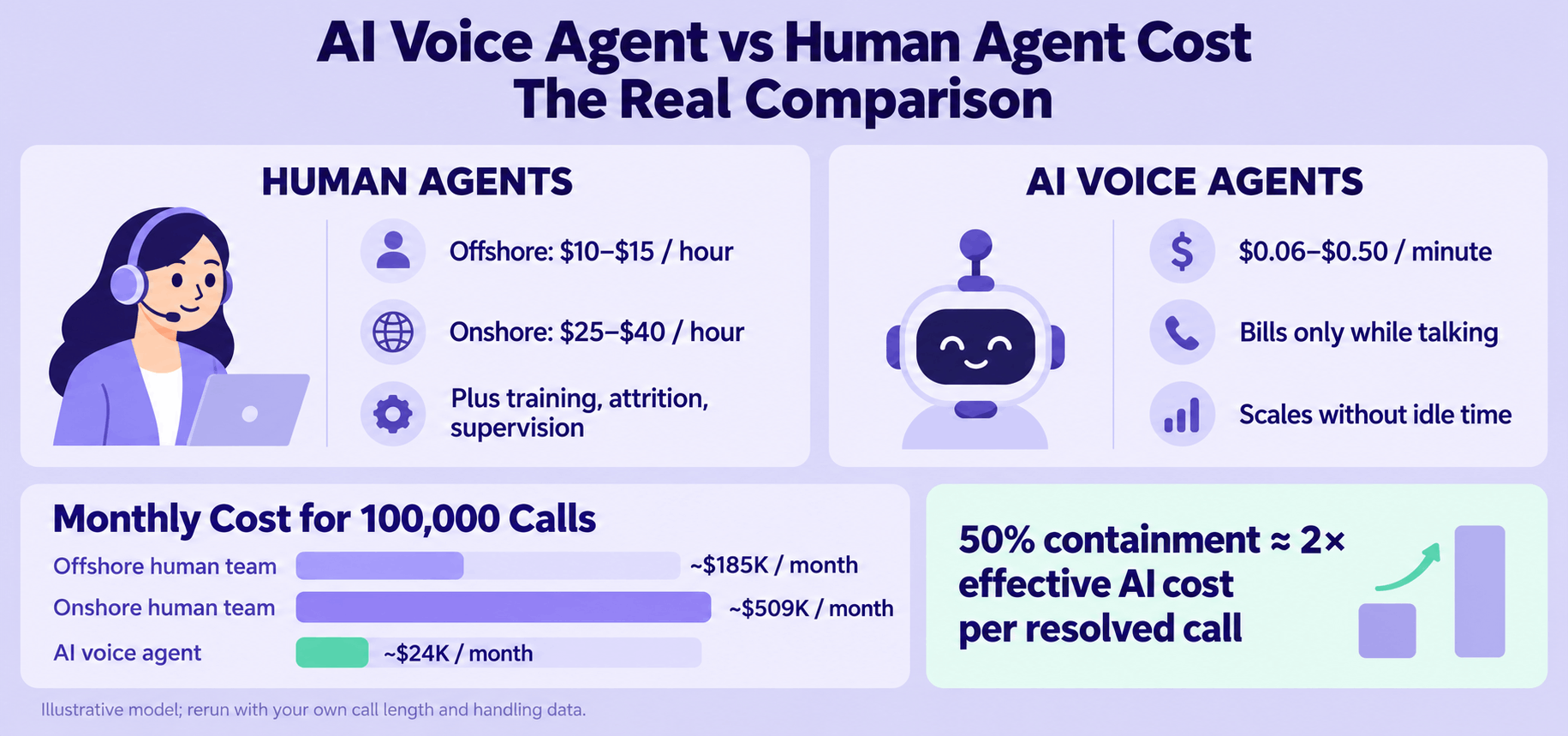
Human cost is more than wages. Offshore agents typically run $10–$15 per hour and onshore agents $25–$40, before attrition, training, supervision, and idle time. AI voice agents cost roughly $0.06–$0.50 per minute and bill only while talking. So the AI voice agent vs human agent cost comparison comes down to volume, handling time, and how many calls the AI resolves on its own.
Volume Turns a Per-Minute Rate Into a Budget
Industry commentary puts offshore agents at roughly $10 to $15 an hour once training, infrastructure, and attrition are included. A 2026 BPO cost structure analysis from Anyreach puts fully loaded offshore costs at roughly $185K per month for 100,000 calls, and onshore teams at about $509,000, after attrition, surge premiums, management overhead, and benefits. At the same volume, modelling puts AI calling agent cost at about $24K. Human totals include attrition, retraining, and management overhead; AI totals include platform, telephony, and support.
Don't take those totals as gospel. Average call length moves the result, so rerun the model with your own data. The AI figure also assumes the call gets resolved, and every escalation costs you both the AI minutes and the human handling time. At 50% containment, the effective AI cost per resolved call roughly doubles, which is why containment is the most important metric in any voice agent business case. Measure it in a pilot before you commit to volume.
How to Calculate AI Voice Agent ROI
Calculating AI voice agent ROI is a ratio problem, not a rate problem. The formula is (human cost avoided + revenue gained) ÷ total AI cost. Total AI cost has to include platform, telephony, setup, integration, maintenance, and oversight, while revenue gained covers after-hours leads captured and faster response. One caution: AI only saves money when it resolves the call, and poor containment erases the advantage quickly.
1. An Illustrative Example With Two Baseline Assumptions
Take 100,000 calls a month at three minutes each, or 300,000 minutes. Assume the AI costs about $0.08 per minute ($24K) and resolves 65% of calls, leaving 35,000 escalations for human agents. The result depends heavily on your true human baseline, so here are two cases. All figures are illustrative run-rate numbers and exclude setup and integration.
| Metric | Case A: $185K baseline | Case B: $75K baseline |
|---|---|---|
| Human cost avoided (65%) | $120,250 | $48,750 |
| Escalations still handled by humans | $64,750 | $26,250 |
| AI run-rate cost | $24,000 | $24,000 |
| Net monthly saving | $96,250 | $24,750 |
| ROI (cost avoided ÷ AI cost) | 5.0x | 2.0x |
Case A uses the fully loaded offshore figure above, about $0.62 per minute. Case B assumes roughly $0.25 per minute, closer to talk-time-only estimates. Your real baseline likely sits somewhere between them, so use your own payroll and call data. The margin is also thin: at $0.50 per AI minute, run-rate cost reaches $150,000 and both cases turn negative. Rate and containment both have to hold before the savings show up.
2. Real Deployments Show What Good Looks Like
Stellantis &You UK runs a virtual receptionist handling 20,000 calls a month and saves about £200K a year on that use case, according to Make. Cars24 reports a 50% cut in calling costs across more than three million minutes of AI-supported calls, as reported by PYMNTS. Both figures are company-reported and specific to their use cases. Payback period is setup cost divided by monthly net savings, so a deployment saving $8,000 a month against $48,000 of setup pays back in six months (an illustration, not a benchmark). For contact centre work, test AI call centre automation cost on one pilot queue before you scale.
AI Voice Agent Cost for Small Businesses vs Enterprise
Small businesses and enterprises sit on different cost curves. A small team can start on entry tiers of roughly $200–$1,000 per month, accepting standard voices, limited integrations, and shared support. Enterprises usually move to $5K–$50K or more per month, or custom contracts. Evaluating an AI voice agent for businesses starts with matching the tier to your volume.
What Changes at Each Tier Is Scope, Not Just Price
- Custom integrations
- Security reviews
- Dedicated support
- Volume commitments
- Compliance controls
If you're comparing enterprise AI voice agent cost, expect those five items to outweigh the per-minute rate. They also stretch procurement, since legal, security, and IT all review the deal. Small businesses can skip most of this, but should still confirm what happens when usage outgrows the entry tier. At scale, conversational AI pricing gets negotiated, so tie your conversational AI pricing to explicit security and compliance commitments.
How to Reduce AI Voice Agent Cost Without Cutting Quality
Savings come from design choices, not from squeezing rate cards. Four levers matter most: model selection, call routing, volume commitments, and integration consolidation. Each cuts waste while protecting resolution quality, the metric that protects your margin. Apply them in sequence during a pilot, then review monthly.
Four Levers Cut Spend While Protecting Resolution
Use lighter models for simple intents and save premium models for complex reasoning; that one choice lowers AI voice agent pricing without any audible quality loss. Route Tier 1 calls, like status checks, bookings, and FAQs, to the AI, and send complex or sensitive calls to humans. Negotiate volume commitments only once usage stabilises, since commitments can reduce AI voice agent cost per minute but punish forecasting errors. Finally, consolidate integrations so one connector serves several workflows instead of paying for duplicates. Track containment weekly, because a cheaper setup that resolves fewer calls costs more overall.
Concluding Note
The honest answer on AI voice agent cost is a range, not a number: $0.04 to $0.50 per minute at the component and platform level, and wider once setup, integrations, and support are included. The comparison with human agents is compelling at volume, but it only holds when the agent resolves calls. Model total cost of ownership, pilot a narrow queue, and measure containment before scaling. Ask every vendor for itemised pricing, then run the ROI math with your own call data. Start small, verify, then expand.
Frequently Asked Questions
How much does an AI voice agent cost per minute?
Published usage rates run from $0.04 to $0.40 per minute at the component level. Business-grade blended rates land at $0.50–$1.50 per minute once telephony, models, and support are included. Enterprise contracts are typically negotiated at $0.10–$0.50 per minute, depending on volume and features.
What are the three AI voice agent pricing models?
Usage-based (per minute or conversation), subscription (a fixed fee with bundled minutes), and hybrid (a base fee plus metered usage). Usage-based suits variable volume, subscription suits steady volume, and hybrid fits growing or enterprise teams.
What hidden costs should I expect beyond the per-minute rate?
Setup fees ($2,500–$250,000 depending on scope), integration work, overages beyond bundled minutes, premium features like voice cloning or advanced analytics, support packages, and ongoing tuning. Ask for itemised quotes to surface these before you sign.
How does AI voice agent cost compare to human agents?
Offshore human agents cost $10–$15 per hour and onshore agents $25–$40, before attrition and management overhead. At 100,000 calls per month, fully loaded offshore costs run roughly $185K and onshore around $509K. AI voice agents cost $0.06–$0.50 per minute, but the comparison depends on containment rate.
What is the containment rate and why does it matter for cost?
Containment rate is the share of calls the AI resolves without escalating to a human. At 50% containment, the effective AI cost per resolved call roughly doubles, because every escalation costs both AI minutes and human handling time. Measure it during a pilot before you commit to volume.
About the author

Deepak Dutta
Content Strategist
Deepak Dutta is a tech-focused content strategist and writer with 9+ years of experience crafting content for emerging technologies and digital products. With deep expertise in Blockchain, Web3, AI, Mobile apps, Web apps and Game development, he creates engaging, SEO-focused content that simplifies complex ideas, strengthens brand authority, and connects technology companies with their target audience.