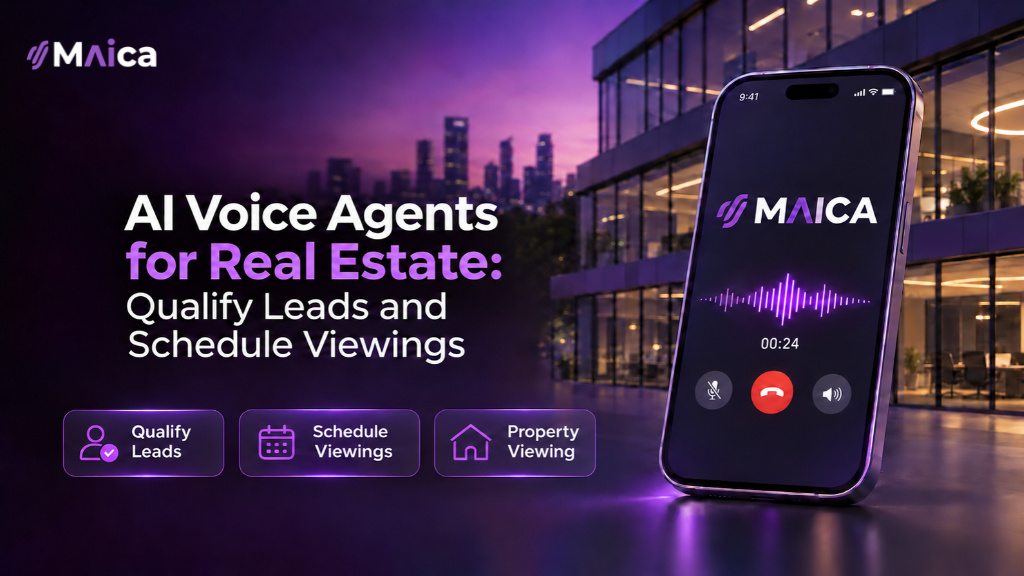
AI Voice Agents for Real Estate: Qualify Leads and Schedule Viewings
- By Deepak Dutta
- 10 min read
Table of Contents
Key Takeaways
- Speed beats everything: responding within seconds wins leads that slow follow-up loses.
- Qualify on budget, timeline, financing, location, and property type before routing.
- Automate viewing booking with live calendars, SMS confirmations, and reminders.
- Hybrid wins: AI handles coverage and volume, ISAs handle nuance and emotion.
- Write escalation rules for upset callers, Fair Housing topics, and price opinions.
- Secure consent, disclose the AI, and pilot platforms against your own baseline.
Introduction
Real estate lead response comes down to who picks up first. The average agent takes about 917 minutes to reply to a new online inquiry, and 78% of buyers end up working with the first agent who does respond. Someone who fills out a form at 9 p.m. isn't going to wait until morning to hear back.
No team can staff that gap around the clock, so portal leads go cold and ad spend gets wasted. AI voice agents for real estate close it by answering or calling within seconds, asking the right questions, and booking a viewing before a competitor gets there.
They don't replace your ISA. They take the first call so your ISA can spend time on the conversations that need a person.
Below, we cover the qualification workflow, viewing scheduling, the hybrid ISA model, and compliance. We'll also be straight about where AI falls short.
The Real Estate Lead Response Problem AI Solves
Lead response is a speed problem first and a qualification problem second. HousingWire's speed-to-lead coverage keeps landing on the same gap: a 917-minute average response time, and buyers who mostly go with whoever replies first.
It gets worse after hours and during spikes. Evening form fills, weekend open-house follow-up, and sudden portal surges all arrive while your agents are out showing homes or asleep, and nobody can cover that volume at every hour.
Why Speed Wins in Real Estate
That's where real estate voice AI helps. AI phone agents for property inquiries can answer in roughly 8 to 25 seconds, at any hour, and take many calls at once. AI voice agents for real estate leads can greet the inquiry, confirm interest, ask the first qualifying questions, and pass a warm summary to a human.
What stays human is pretty clear. Pricing strategy, listing-appointment persuasion, emotional conversations, and negotiation belong to your people. The AI's job is to hand them a qualified, scheduled lead instead of a cold one.
Speed alone doesn't convert, though. A fast reply with no qualification is just a faster dead end, so that first call also has to find out whether the lead is ready to buy, sell, or just browsing.
How AI Voice Agents Qualify Real Estate Leads
Good AI-powered real estate lead generation doesn't stop at capturing the lead. Someone has to figure out whether that lead is ready, and that's what real estate AI lead qualification does.
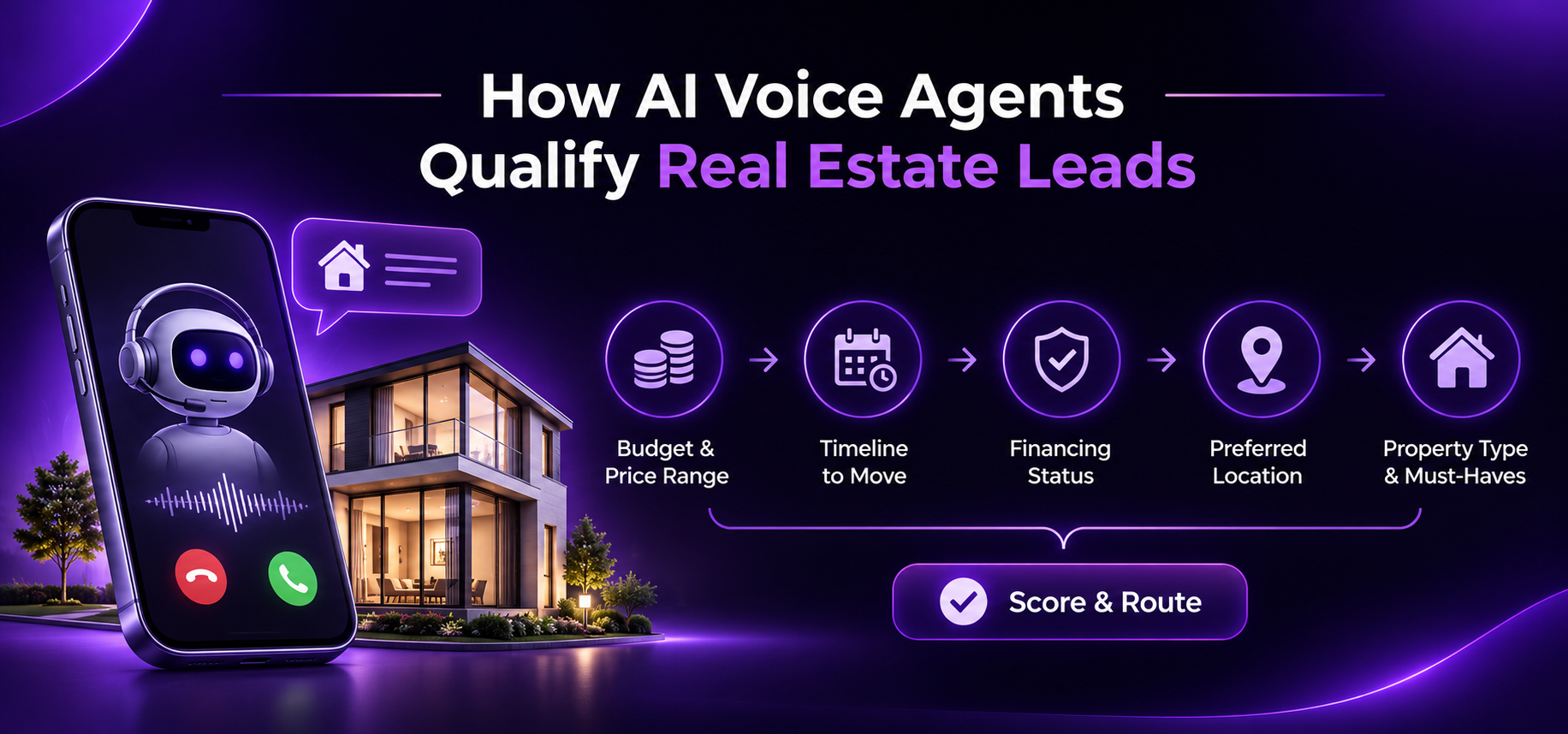
1. The Five Qualification Areas
A good call feels like a conversation, not a form. The agent works through five areas, usually in this order:
- Budget and price range
- Timeline to move
- Financing status
- Preferred location
- Property type and must-haves
Keep it short. Ask one question at a time, acknowledge each answer, and aim to finish in under three minutes.
2. Scoring and Routing
Each answer feeds a score. A lead with a clear budget, a move date within 90 days, and pre-approval scores hot and goes to a live agent or straight to a calendar. A vague timeline and no financing keeps a lead in an automated nurture cadence.
Set the thresholds with your ISA manager and review them monthly. At first, check a sample of scored calls every week. If hot leads keep stalling or warm ones keep converting, adjust the thresholds instead of trusting the first version.
3. Buyer and Seller Flows
Buyer calls focus on search criteria and readiness. Seller calls cover the property address, why they're selling, timing, and whether they've already talked to another agent. Either way, the call ends with a summary in your CRM and a human taking over at the right moment.
For setup details, Retell AI's real estate assistant page outlines how lead-calling agents are configured, which is a handy reference when you draft your own script.
Automating Property Viewing Scheduling
Qualification only pays off if it ends in a booked viewing. Automated property viewing scheduling turns a warm call into a calendar entry before the lead loses interest. Teams that automate property viewing appointments also get their agents out of the calendar and into showings.
1. The Booking Flow
An AI voice agent for scheduling property viewings follows a fairly predictable flow. It checks the agent's live calendar, offers two or three slots, confirms the choice by voice, and texts a confirmation with the address and a reschedule link.
Availability checks need guardrails: drive-time buffers between showings, agent days off, and listing-specific access rules like lockboxes or occupied homes. Without them, the automation books slots a human can't keep.
2. Reschedules and No-Show Reduction
Reschedules are where automation quietly saves hours. When a lead calls or texts to move a showing, the agent frees the old slot, offers new times, and updates the calendar and CRM. Nobody plays phone tag.
No-shows drop when leads get several touchpoints: a confirmation right away, a reminder the day before, and a quick call or text the morning of. Ask for a reply to confirm, and release unconfirmed slots to other leads.
Maica builds voice and chat agents for this kind of lead conversion, and its Product Hunt listing shows how the product is positioned.
The Hybrid ISA Model: AI Plus Human
The realistic setup is hybrid. AI covers after-hours calls, volume spikes, and the follow-up cadence that busy ISAs struggle to keep up. Your ISA handles the nuanced qualification, the emotional calls, and the negotiation.
1. Why the Division Works
It works because real estate conversational AI is strong on consistency and humans are strong on judgment. An AI calling agent for real estate never forgets a follow-up, but it can't read a hesitant seller's tone the way an experienced ISA can.
Cost helps make the case. A human ISA means salary, benefits, training, and coaching time. According to Callingly's ISA guide, AI ISA plans typically run about $100 to $750 per month, with usage-based pricing, so your bill follows lead volume.
Cost isn't the whole story, though. The bigger gain is coverage. An ISA works one shift, while AI answers a 9 p.m. Sunday inquiry the same way it answers a Tuesday noon call.
2. AI vs Human ISA Comparison
| Factor | AI Voice Agent | Human ISA |
|---|---|---|
| Response speed | 8–25 seconds | Minutes to hours |
| Availability | 24/7, parallel calls | Shift-based, one call at a time |
| Consistency | Same script every call | Varies by person and day |
| Nuanced qualification | Limited | Strong |
| Emotional calls and negotiation | Escalates to human | Strong |
| Monthly cost | About $100–$750 | Salary, benefits, training |
Treat the table as a staffing guide, not a scorecard. The point isn't to win on cost; it's to put each conversation with the right responder.
What AI Voice Agents Cannot Do (Yet)
Let's be honest about the limits. Voice assistants for real estate still struggle with complex negotiations, emotional de-escalation, and situations that fall outside the script.
1. Fair Housing Risk
Fair Housing is a particular risk, because an AI can steer a conversation in ways a trained professional would avoid. Escalation rules close the gap. Transfer to a human when a caller sounds upset, asks about neighborhood demographics or protected classes, wants a price opinion, or raises something the agent can't answer confidently.
Those limits aren't something to hide, so build around them. A quick, honest handoff beats an AI that bluffs through a question it can't answer.
2. Testing for Failure Modes
Test before launch. Call your own agent with interruptions, heavy accents, background noise, and off-topic questions, and log every miss so you can fix the script.
Real estate sales automation works best when handoffs are fast and the human gets the full call summary. A warm transfer feels like service; a cold one feels like a dropped call.
Compliance and Security for Real Estate Voice AI
Outbound calling carries legal weight. The FCC has confirmed that AI-generated voices count as artificial voices under the TCPA, as this Orrick analysis explains. In practice, marketing calls need prior express written consent.
1. The Four Compliance Basics
A compliant program covers four basics. Capture and store consent for every outbound number, tell people at the start of the call that they're speaking with an AI, scrub against national and state do-not-call lists, and review every script for Fair Housing risk before launch.
Keep records, too: consent logs, call recordings where lawful, and a changelog of script edits, so you can prove what the agent said and when.
2. Security and Data Handling
Security matters as much as the script. Recordings and transcripts hold financial details and personal preferences, so confirm encryption, retention controls, and access permissions. Check how real estate AI lead qualification data is stored before you connect it to your CRM.
None of this is legal advice. Have counsel review your consent language and call scripts before the first campaign.
Choosing an AI Voice Agent Platform for Real Estate
Start with the CRM. The platform should write call outcomes, scores, and booked viewings back to your system without manual work. Check native integrations first, then confirm that an AI calling agent for real estate can use your calendar and lead sources.
1. What to Test in a Live Demo
Next, test latency, language support, and escalation quality. Awkward pauses erode trust fast, multilingual coverage matters in diverse markets, and a transfer that drops context defeats the purpose. Listen to live sample calls, not just the polished demo.
Dig into escalation. Does the handoff include a transcript, a lead score, and the caller's stated timeline? Can the transfer happen mid-call, or only by callback? The answers separate a smooth pilot from a frustrating one.
2. Data Ownership and Pricing Models
Ask about data ownership, too: who keeps the recordings, transcripts, and lead data if you leave?
Then compare pricing carefully. Per-minute, per-call, and flat-rate models behave differently as volume grows, so plug in your real lead and call counts. Plura AI's receptionist pricing comparison is a useful starting point for benchmarking.
Run a 30-day pilot before you commit. See how Maica prices real estate voice AI, compare it against your shortlist, and track speed-to-lead, qualified-lead rate, booked viewings, and show rate. Make sure automated property viewing scheduling works end to end with your calendar.
Concluding Note
Real estate lead response is a speed problem first and a qualification problem second. AI voice agents for real estate handle the speed part by answering in seconds, qualifying consistently, and booking viewings at any hour.
They don't handle nuance. Fair Housing judgment, emotional conversations, and negotiation still belong to your ISA and agents, which is why the hybrid model is the realistic way to deploy. Used that way, AI protects your lead spend and frees your people for the work only they can do.
Start small. Audit your current response time, set your qualification thresholds, write escalation rules, and pilot one lead source for 30 days. The numbers will tell you whether the model fits your team. Speed is the one advantage every team can build quickly upon.
Frequently Asked Questions
How do AI voice agents qualify real estate leads?
They run a short conversational script covering budget, timeline, financing, location, and property type. Each answer feeds a score that sends hot leads to a live agent or calendar and keeps the rest in an automated nurture cadence.
Can AI voice agents schedule property viewings automatically?
Yes. They check the agent's live calendar, offer a few slots, confirm by voice, and text a confirmation with the address and a reschedule link. Reminders the day before and the morning of cut down on no-shows.
Will AI voice agents replace human ISAs?
No. AI covers after-hours calls, volume spikes, and follow-up cadence. Your ISA keeps the nuanced qualification, emotional calls, negotiation, and Fair Housing judgment.
How fast do AI voice agents respond to new leads?
Typically in 8 to 25 seconds, at any hour, compared with an industry average of roughly 917 minutes for humans. With 78% of buyers going with the first agent to respond, that gap matters a lot.
How much do AI voice agents cost for real estate?
AI ISA plans typically run $100 to $750 per month, with usage-based pricing tied to lead volume. A human ISA costs salary plus benefits, training, and coaching time.
What compliance rules apply to AI outbound calls in real estate?
The FCC has confirmed that AI-generated voices count as artificial voices under the TCPA, so marketing calls need prior express written consent. Store consent records, disclose the AI at the start of the call, scrub against DNC lists, and review scripts for Fair Housing risk.
What should I test in a platform demo before committing?
Check latency, language support, escalation quality (does the handoff include a transcript and lead score?), CRM and calendar integrations, data ownership, and how pricing scales with volume. Listen to live sample calls, not just a demo.
How do I handle Fair Housing compliance with AI voice agents?
Write escalation rules that transfer to a human when a caller asks about neighborhood demographics, protected classes, or anything the agent can't answer confidently. Have counsel review scripts before launch, and keep call logs so you can show what the agent said.
Can AI voice agents handle both buyer and seller inquiries?
Yes, with different flows. Buyer calls cover search criteria, financing, and readiness; seller calls cover the property address, reason for selling, timing, and whether the owner has talked to another agent. Both end with a CRM summary and a warm handoff.
What is a realistic pilot timeline for AI voice agents?
Run a 30-day pilot on one lead source. Track speed-to-lead, qualified-lead rate, booked viewings, and show rate against your baseline, review calls weekly, and adjust thresholds before you expand.
About the author

Deepak Dutta
Content Strategist
Deepak Dutta is a tech-focused content strategist and writer with 9+ years of experience crafting content for emerging technologies and digital products. With deep expertise in Blockchain, Web3, AI, Mobile apps, Web apps and Game development, he creates engaging, SEO-focused content that simplifies complex ideas, strengthens brand authority, and connects technology companies with their target audience.